EquilibriumArm Valves
Balanced-pressure filling.

1/2' Equilibrium Straight Arm Float Valve with float
£78.70EX VAT · £94.44 INCView product
3/4' Equilibrium Straight Arm Float Valve with float
£97.00EX VAT · £116.40 INCView product
1' Equilibrium Straight Arm Float Valve with float
£154.00EX VAT · £184.80 INCView product
1' Equilibrium Drop Arm Float Valve with float
£194.00EX VAT · £232.80 INCView product
1 1/4' Equilibrium Straight Arm Float Valve with float
£293.00EX VAT · £351.60 INCView product
1 1/4' Equilibrium Drop Arm Float Valve with float
£339.00EX VAT · £406.80 INCView product
1 1/2' Equilibrium Drop Arm Float Valve with float
£389.00EX VAT · £466.80 INCView product
2' Equilibrium Straight Arm Float Valve with float
£566.00EX VAT · £679.20 INCView product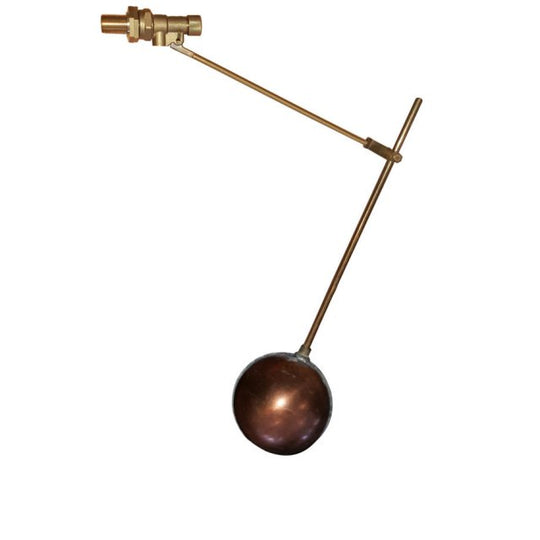
2' Equilibrium Drop Arm Float Valve with float
£613.00EX VAT · £735.60 INCView product
2 1/2' Equilibrium Straight Arm Float Valve with float
£886.00EX VAT · £1,063.20 INCView product
3' Equilibrium Straight Arm Float Valve with float
£1,291.00EX VAT · £1,549.20 INCView product
3' Equilibrium Drop Arm Float Valve with float
£1,330.00EX VAT · £1,596.00 INCView product
4' Equilibrium Straight Arm Float Valve with float
£2,185.00EX VAT · £2,622.00 INCView product
4' Equilibrium Float Valve with drop arm with float
£2,340.00EX VAT · £2,808.00 INCView product


Talk to a
specialist
Sizing, regulations, installation. Our team has been answering these questions for over 25 years.
Equilibrium Arm Valves FAQs
What is an equilibrium arm valve and how does it differ from a standard float valve?
An equilibrium valve uses a piston with water channelled to both sides, so incoming mains pressure is balanced out rather than pushing against the float alone. This means the float only has to overcome friction, not full mains pressure, making it far more reliable on high-pressure supplies or larger cisterns where a standard Portsmouth or diaphragm valve would struggle to shut off cleanly.
When should I fit an equilibrium valve instead of a standard ball valve?
They're the right choice on high-pressure mains supplies, larger cold water storage cisterns, or any installation where a standard valve has a history of dribbling, slamming or failing to close fully. If your incoming pressure is above around 3 bar, or you've had noisy water hammer with a conventional valve, an equilibrium arm valve is usually the fix.
What sizes are available and how do I choose the right one?
Equilibrium arm valves are commonly available in 1/2", 3/4" and 1" BSP, matched to your incoming supply pipe size and the fill rate the cistern needs. Undersizing leads to slow refill after high demand; for most domestic cold water storage cisterns 3/4" is standard, with 1" used on larger commercial or high-turnover tanks.
Are equilibrium arm valves WRAS approved for potable water use?
Yes, the valves we supply are WRAS approved for use on wholesome (potable) water storage, meeting the requirements of the Water Supply (Water Fittings) Regulations. Always check the specific product listing for the WRAS approval number and confirm it's suited to your water category before installation.
How do I adjust the water level once the valve is fitted?
Water level is set by bending or adjusting the float arm, not by altering the valve body itself, so raise or lower the float to bring the shut-off point up or down. Always leave adequate air gap below the warning/overflow pipe as required by Building Regulations Part G, and check the level again once the cistern has settled after first fill.
My equilibrium valve won't shut off fully — what usually causes this?
The most common cause is debris or scale lodged in the small equalising channel or seat, which stops the piston balancing correctly, so it's worth isolating the supply and inspecting for grit, particularly on new-build or recently disturbed mains. A worn diaphragm or seal, or a float arm bent too shallow, can also prevent full closure and will need the relevant part replaced.